
The subsequent Third Intermediate Period marked the end of the New Kingdom's empire and saw the rise of several native dynasties, the Libyan and Nubian kingdoms, and later the Assyrian and Persian conquests. The Ptolemaic Kingdom, established in 332 BC after the death of Alexander the Great, ruled Egypt until 30 BC, when Egypt became a province of the Roman Empire.The ancient Egyptians developed a complex society, characterized by a system of government headed by a pharaoh, a bureaucracy, and a large military. They also developed a sophisticated religion, art, and architecture.
Ancient Egyptian society
Ancient Egyptian society was a hierarchical society, with the pharaoh at the top. The pharaoh was considered to be a god and was the head of state, religion, and military. The pharaoh was assisted by a bureaucracy of officials who oversaw the day-to-day running of the country.
The next level of society was made up of the nobility, which included the royal family, high-ranking officials, and priests. The nobility owned land and enjoyed many privileges.
The middle class consisted of merchants, artisans, and farmers. Merchants traded goods throughout the Mediterranean region, artisans produced goods such as pottery, jewelry, and furniture, and farmers worked the land to produce food.
The lower class consisted of slaves, who were usually prisoners of war or criminals. Slaves were often used as laborers or in the military.
Ancient Egyptian religion
Ancient Egyptian religion was a polytheistic religion, with many gods and goddesses. The most important gods included Ra, the sun god; Osiris, the god of the underworld; and Isis, the goddess of motherhood and magic.
The ancient Egyptians believed in an afterlife, and they prepared for it by mummifying their dead and burying them with their possessions. They also believed in reincarnation, and they hoped to be reborn into a better life.
Ancient Egyptian art
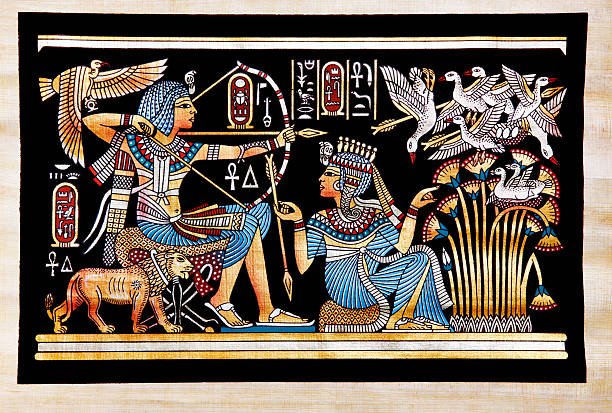
Ancient Egyptian art was characterized by its realism and its use of hieroglyphs. Hieroglyphs were a system of writing that used pictures to represent words and sounds.
Ancient Egyptian art was used to depict the gods, the pharaohs, and everyday life. It was also used to decorate temples, tombs, and other buildings.
Ancient Egyptian architecture
Ancient Egyptian architecture was characterized by its monumentality and its use of stone. The most famous examples of ancient Egyptian architecture are the pyramids, which were tombs for the pharaohs.
Ancient Egyptians also built temples, tombs, and other buildings. Their architecture was often decorated with hieroglyphs and other artwork.
Ancient Egyptian legacy
Ancient Egypt left a lasting legacy on the world. Its art, architecture, and religion have influenced cultures around the globe. The ancient Egyptians also developed many technologies that are still used today, such as the calendar and the irrigation system.Ancient Egypt is a fascinating civilization that continues to be studied and admired by people all over the world.


