
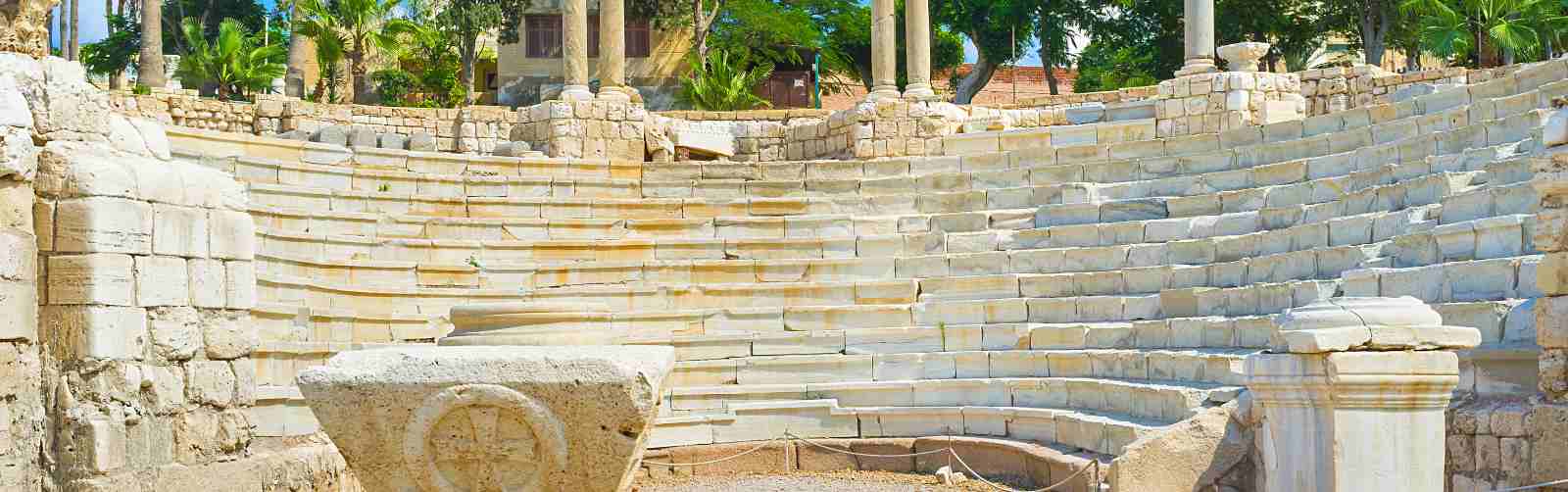
The Roman amphitheater of Alexandria, also known as the Kom El Dikka theater, is a well-preserved ancient amphitheater located in the heart of Alexandria, Egypt. Here are some key points about this historic site:
-
Location: The Roman amphitheater is situated within the Kom El Dikka archaeological site, which is located in the center of modern-day Alexandria. The site was once part of the ancient city's urban fabric and served as a cultural and entertainment hub during the Roman period.
-
Construction: The amphitheater was built during the Roman era, likely in the 2nd or 3rd century CE, during the reign of the Roman Emperor Antoninus Pius. It was constructed using local limestone and marlstone, with a capacity estimated to be around 800 spectators. The theater followed the typical semi-circular design of Roman amphitheaters, with tiered seating arranged around a central performance area (orchestra) and a stage (scaenae frons) at the rear.
-
Function: Like other Roman amphitheaters, the one in Alexandria was used for various forms of entertainment and public spectacles, including theatrical performances, gladiatorial contests, animal hunts (venationes), and public executions. These events served as popular forms of entertainment and were often attended by people from all walks of life.
-
Archaeological Excavations: The site of the Roman amphitheater was excavated in the 1960s and 1970s by Polish archaeologists, uncovering the remains of the ancient theater and other structures within the Kom El Dikka complex. The excavations revealed well-preserved architectural features, including seating sections, passageways, and decorative elements, providing valuable insights into the layout and design of Roman theaters.
-
Preservation and Restoration: The Roman amphitheater and the surrounding archaeological site have undergone extensive conservation and restoration efforts to protect and showcase their historical significance. Today, visitors can explore the remains of the amphitheater, as well as other structures such as a Roman villa, a small theater, and public baths, which offer glimpses into daily life in ancient Alexandria.
-
Cultural Heritage: The Roman amphitheater of Alexandria is an important cultural and historical landmark, representing the city's rich heritage and its role as a vibrant center of Roman civilization in Egypt. The site attracts tourists, scholars, and history enthusiasts who come to learn about the ancient past and experience the legacy of Alexandria's classical era.
-
Design and Architecture: The Roman amphitheater of Alexandria follows the typical architectural style of Roman theaters and amphitheaters. It features a semi-circular seating area (cavea) divided into several sections (cunei) by staircases and aisles. The theater's stage (scaenae frons) would have been elaborately decorated with columns, statues, and architectural motifs, serving as a backdrop for performances.
-
Cultural Significance: The presence of a Roman amphitheater in Alexandria highlights the city's cosmopolitan character and its integration into the broader Roman Empire. It served as a venue for cultural exchange, where Greek, Egyptian, and Roman traditions converged in the form of theatrical performances, gladiatorial contests, and other public spectacles.
-
Integration into Urban Landscape: The Roman amphitheater was part of a larger urban complex that included residential, commercial, and religious structures. Its location within the Kom El Dikka archaeological site reflects its central position within the ancient city, surrounded by bustling streets and bustling neighborhoods. The theater would have been a focal point of social life, drawing crowds from across Alexandria and beyond.
-
Legacy and Influence: Although the Roman amphitheater of Alexandria fell into disuse and disrepair over the centuries, its remnants serve as a tangible link to the city's classical past. The site stands as a reminder of Alexandria's cultural richness and its enduring significance as a center of learning, creativity, and innovation in the ancient world.
-
Tourism and Education: Today, the Roman amphitheater of Alexandria is open to visitors, offering opportunities to explore the archaeological remains and learn about the city's history through guided tours and interpretive exhibits. The site contributes to tourism in Alexandria, attracting visitors interested in ancient history, archaeology, and architecture.
-
Research and Study: The Roman amphitheater continues to be a subject of scholarly research and archaeological investigation. Ongoing studies aim to uncover more about its construction, use, and cultural significance, shedding light on the dynamics of urban life in ancient Alexandria and the broader Roman Empire.
Overall, the Roman amphitheater of Alexandria represents an important chapter in the city's history and serves as a tangible link to its classical past. Its preservation and interpretation contribute to our understanding of ancient urbanism, cultural exchange, and the enduring legacy of Alexandria as a center of civilization.


